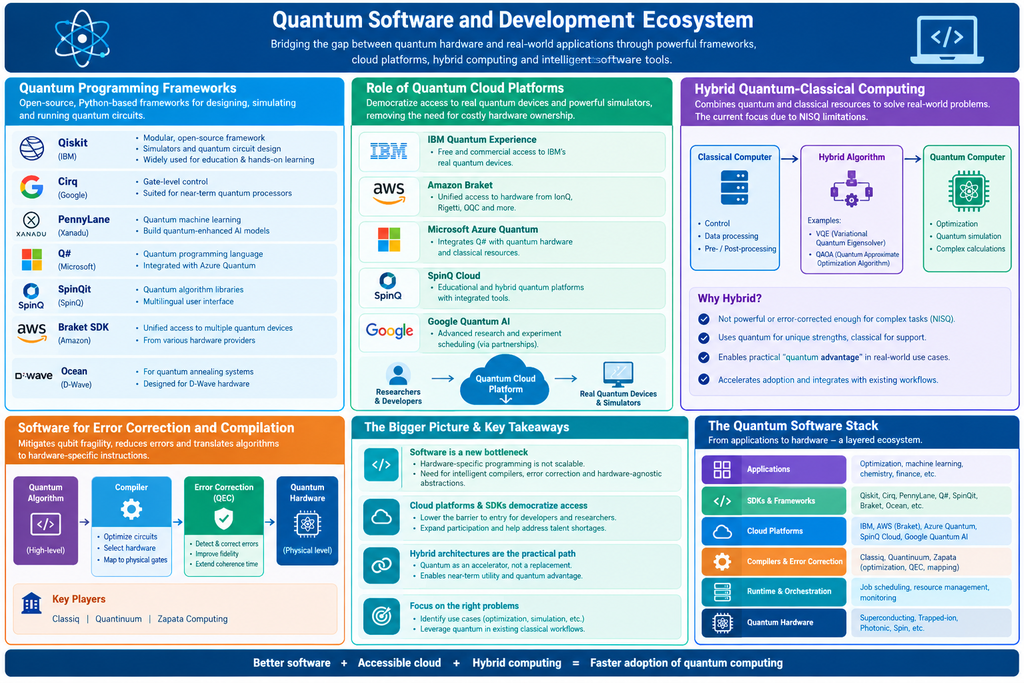
The maturation of quantum computing extends beyond hardware advancements to encompass a robust software and development ecosystem. This layer is crucial for translating complex classical problems into executable quantum instructions and for making quantum resources accessible to a broader user base.
Quantum Programming Frameworks
The development of quantum software is a critical component for unlocking the potential of quantum hardware. To facilitate this, several popular, often Python-based, open-source frameworks have emerged, providing essential tools for quantum circuit design, simulation, and execution on physical quantum hardware or cloud emulators.
- Qiskit (IBM): This is a modular, Python-based, and open-source framework that includes simulators and tools for designing quantum circuits. It is widely adopted for educational purposes and hands-on quantum programming.
- Cirq (Google): Designed with an emphasis on gate-level control, Cirq is particularly suited for programming near-term quantum processors.
- PennyLane (Xanadu): This framework is specifically focused on quantum machine learning, providing tools for developing quantum-enhanced AI models.
- Q# (Microsoft): Integrated within the Azure Quantum platform, Q# offers a dedicated language for quantum programming.
- SpinQit (SpinQ): This framework provides a rich collection of quantum algorithm libraries and features a multilingual user interface, tailored for educators and researchers globally.
- Braket SDK (Amazon): As part of Amazon Web Services (AWS), the Braket SDK offers a unified interface for accessing multiple quantum devices from various hardware providers.
- Ocean (D-Wave): This framework is specifically designed for programming quantum annealing systems, such as those developed by D-Wave Systems.
Role of Quantum Cloud Platforms
Given the substantial cost and inherent complexity of quantum computing hardware, direct ownership and maintenance are prohibitive for most organizations. Quantum cloud platforms have emerged as a transformative solution, democratizing access to real quantum devices and powerful simulators. These services enable researchers, businesses, and even hobbyists to experiment with quantum computing remotely.
- IBM Quantum Experience: This platform offers both free and commercial cloud-based access to IBM’s fleet of real quantum devices.
- Amazon Braket: Provides unified access to quantum hardware from diverse providers, including IonQ, Rigetti, and OQC, through the AWS cloud infrastructure.
- Microsoft Azure Quantum: This platform integrates Microsoft’s Q# programming language with access to various quantum hardware options and classical computing resources.
- SpinQ Cloud: Offers educational and hybrid quantum platforms, complete with integrated software tools, to a global user base.
- Google Quantum AI: Primarily supports advanced quantum research and experiment scheduling, typically through established research partnerships.
Hybrid Quantum-Classical Computing Approaches
The current generation of quantum computers, often categorized as Noisy Intermediate-Scale Quantum (NISQ) devices, are not yet sufficiently powerful or error-corrected to operate entirely independently for complex, large-scale problems. Consequently, the industry’s focus has strategically shifted towards hybrid algorithms that combine the strengths of both quantum and classical computing hardware. In this co-processing architecture, quantum computers are leveraged for their unique capabilities in computationally intensive tasks, such as optimization and the simulation of quantum systems. Meanwhile, classical computers handle essential functions like control, data processing, and the pre- and post-processing of quantum results. Examples of such hybrid algorithms include the Variational Quantum Eigensolver (VQE) and the Quantum Approximate Optimization Algorithm (QAOA). This integrated approach represents the primary focus of practical near-term quantum software development.
Software for Error Correction and Compilation
Given the inherent fragility of qubits and the high error rates in current quantum hardware, software-driven quantum error correction (QEC) and intelligent compilers are becoming increasingly critical components of the quantum stack. These sophisticated software tools are designed to optimize quantum circuits to minimize errors, intelligently select the most suitable hardware configurations for specific computations, and translate abstract quantum algorithms into precise physical-level instructions for the quantum processor. Companies such as Classiq, Quantinuum, and Zapata Computing are actively developing these advanced quantum software layers.
A significant development in the quantum computing landscape is that software development is emerging as a new bottleneck, concurrently driving the democratization of access to quantum resources. This understanding arises from the observation that hardware-specific programming is not scalable, and the inherent error rates of quantum systems necessitate intelligent compiler and correction tools, while the diversity of quantum platforms demands hardware-agnostic abstractions. The proliferation of cloud platforms and user-friendly Software Development Kits (SDKs) directly addresses this challenge by lowering the barrier to entry for developers and researchers who may not possess deep hardware expertise or direct access to physical quantum machines. This suggests a strategic pivot within the quantum computing industry: while continuous hardware innovation remains vital, a growing emphasis is placed on cultivating a robust and accessible software ecosystem. This shift is expected to accelerate adoption by broadening participation and partially mitigating the existing talent shortage in the field.
Furthermore, hybrid quantum-classical architectures are recognized as the pragmatic pathway to achieving near-term utility, underscoring the complementary nature of quantum and classical computing. This perspective is grounded in the understanding that quantum computers are not designed to fully replace classical systems for everyday tasks. Instead, hybrid systems are becoming the prevalent architectural strategy, integrating quantum processing units with classical computing resources. This integrated approach will be crucial for achieving practical “quantum advantage” in real-world applications before fully fault-tolerant quantum computers become widely available. Organizations should therefore focus on strategically identifying problems where quantum’s unique strengths, such as optimization or the simulation of quantum systems, can provide a significant computational acceleration or enable previously impossible calculations. This involves leveraging quantum capabilities as a specialized accelerator within existing classical workflows, rather than attempting a complete transition of all computational tasks.