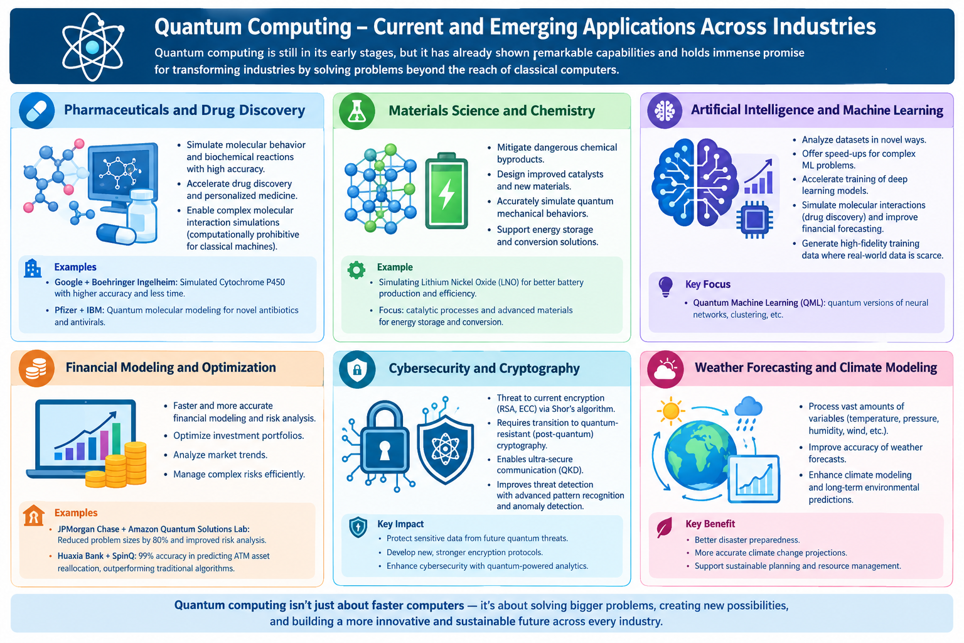
Quantum computing, while still in its nascent stages, has demonstrated capabilities and holds immense promise for revolutionizing various industries by tackling problems currently beyond the reach of classical computation.
Pharmaceuticals and Drug Discovery
Quantum computers are poised to significantly accelerate the research and development of new drugs and medical treatments by simulating molecular behavior and biochemical reactions with unprecedented accuracy. For instance, Google, in collaboration with pharmaceutical company Boehringer Ingelheim, has demonstrated the ability of quantum computers to simulate a key structure of Cytochrome P450, an enzyme crucial for drug effectiveness, with higher accuracy and in less time than classical methods. Similarly, Pfizer and IBM are leveraging quantum molecular modeling in their search for novel antibiotics and antivirals. The potential extends to enhancing drug discovery and personalized medicine by enabling the simulation of complex molecular interactions at an atomic level, a task computationally prohibitive for classical machines.
Materials Science and Chemistry
In materials science and chemistry, quantum computers can provide innovative solutions for mitigating dangerous chemical byproducts and developing improved catalysts. Their ability to accurately simulate quantum mechanical behaviors is critical for designing new materials. For example, quantum computers are being explored to simulate Lithium Nickel Oxide (LNO), a material used in batteries that is challenging to produce industrially and whose chemistry is not fully understood. Such simulations could lead to improved industrial production processes and the creation of more efficient batteries with a smaller environmental footprint. Key areas of focus include simulating catalytic processes and designing advanced materials for energy storage and conversion.
Artificial Intelligence and Machine Learning
Quantum computing is anticipated to significantly enhance Artificial Intelligence (AI) and Machine Learning (ML) capabilities. Quantum algorithms can analyze datasets in novel ways, potentially offering substantial speed-ups for complex machine learning problems. This includes dramatically accelerating machine learning processes, optimizing functions that would overwhelm classical systems, and speeding up the training of deep learning models. Quantum AI can simulate molecular interactions at an atomic level, which is beneficial for drug discovery, and can be combined with AI predictive models for more accurate financial forecasting. Furthermore, quantum computers could generate high-fidelity training data for domains where real-world data is scarce, such as pharmaceuticals and materials design. The emerging field of Quantum Machine Learning (QML) is dedicated to creating quantum versions of classical algorithms like neural networks and clustering techniques.
Financial Modeling and Optimization
The finance industry stands to benefit from quantum computing’s capacity for faster and more accurate financial modeling and risk analysis. Quantum algorithms can optimize investment portfolios, analyze market trends, and manage complex risks with greater efficiency. For instance, JPMorgan Chase and the Amazon Quantum Solutions Lab are utilizing quantum tools to optimize portfolios, reportedly reducing problem sizes by 80% and improving risk analysis accuracy. Similarly, a collaboration between Huaxia Bank and SpinQ resulted in a quantum neural network that achieved 99% accuracy in predicting ATM asset reallocation, outperforming traditional algorithms in both speed and precision.
Cybersecurity and Cryptography
Quantum computing presents a dual impact on cybersecurity. On one hand, the immense computational power of quantum computers, particularly through algorithms like Shor’s, poses a significant threat to current widely used encryption methods such as RSA and Elliptic Curve Cryptography (ECC), which rely on the difficulty of factoring large numbers. This necessitates a global transition to new, stronger quantum-resistant encryption protocols, known as post-quantum cryptography, to safeguard sensitive data against future quantum threats. On the other hand, quantum computing also enables the development of highly secure communication methods, such as Quantum Key Distribution (QKD) systems, which provide ultra-secure key exchange. Furthermore, quantum computers can enhance cybersecurity threat detection through advanced pattern recognition and anomaly detection in complex ecosystems.
Weather Forecasting and Climate Modeling
Quantum computers can significantly improve the accuracy of weather forecasting by efficiently processing a vast range of variables, such as air temperature, humidity, and pressure, which are computationally intensive for classical systems. This capability extends to predicting global weather changes, offering crucial tools for tackling climate change. Quantum systems have demonstrated the ability to produce forecasts in seconds with 30-50% improved accuracy, which could enhance disaster preparedness and response. Rigetti Computing, for example, has introduced a hybrid quantum-classical system for weather modeling that generates synthetic weather radar images, particularly useful for areas without traditional radar coverage. Beyond forecasting, quantum technology is also improving environmental monitoring, with quantum sensors capable of measuring CO2 emissions with parts-per-billion precision, and simulations aiding in the design of catalysts for direct air capture systems.
Logistics and Supply Chain Management
The optimization of complex logistics and supply chain problems is another area where quantum computing can yield substantial cost savings and improved efficiency. Companies like DHL have already utilized quantum algorithms to reduce delivery times by 20% on international shipping routes by analyzing millions of potential routes simultaneously. Amazon Web Services is exploring quantum-powered warehouse management systems to optimize global inventory distribution, while ExxonMobil, in collaboration with IBM Research, is investigating quantum solutions for optimizing maritime inventory routes in liquefied natural gas shipping. These quantum-enhanced optimization capabilities can lead to significant reductions in fuel costs, improved forecasting accuracy, and overall operational cost reductions.
Quantum computing’s influence is projected to extend to several other sectors:
- Synthetic Biology: Leveraging nanophotonics, quantum computing can accelerate the development of low-energy protein configurations and synthetic amino acids, thereby boosting the development of biochips and biosensors for enhanced patient diagnostics and drug delivery.
- Energy Grids: Quantum computing is poised to revolutionize energy systems by enabling real-time monitoring and advanced modeling of electric grids. This capability is critical for the efficient integration of distributed renewable energy sources and managing the growing demand from electric vehicles and data centers.
- Water Systems: Quantum algorithms can optimize municipal and industrial water systems by identifying optimal sensor placements, setting valve pressures, and managing pump operations to significantly reduce water loss from leaks and inefficiencies.
- Retirement Plans: The combination of AI and quantum computing could lead to quantum-enhanced 401(k) plans offering hyper-personalized portfolios with real-time rebalancing based on complex quantum simulations, providing greater stability against market volatility.
The concept of “quantum advantage” is currently problem-specific and frequently achieved through hybrid approaches, rather than universal supremacy. While demonstrations of quantum supremacy, such as Google’s Sycamore processor solving random circuit sampling problems, have marked significant theoretical milestones , these achievements often pertain to highly specialized, non-utility problems. The more practical applications currently being explored and demonstrated in fields like drug discovery, finance, and logistics typically rely on
hybrid quantum-classical systems, where quantum processors act as accelerators for specific computationally intensive sub-problems. Even for specialized quantum annealers like D-Wave’s, which claim quantum advantage in optimization, it is explicitly stated that they are not universal quantum computers. Furthermore, advanced classical algorithms are continuously improving and, in some instances, have shown competitive performance or even surpassed certain quantum demonstrations. This implies that the immediate value of quantum computing lies in its specialized capabilities for particular computationally intensive tasks where it can provide a distinct advantage, rather than serving as a broad-spectrum replacement for classical systems. Organizations should therefore strategically identify “quantum-ready” problems within their operations—those that are currently intractable or highly inefficient for classical methods and can genuinely benefit from quantum’s unique strengths in optimization or simulation of quantum systems. The focus should be on integrating quantum capabilities into existing workflows as a specialized accelerator, rather than attempting a wholesale technological transition. This dynamic also highlights the ongoing, vigorous competition between quantum and advanced classical algorithms, which continues to push the boundaries of both fields.
Moreover, quantum computing’s impact extends beyond mere computation to fundamental scientific discovery and systemic optimization. Applications such as simulating the Cytochrome P450 enzyme, Lithium Nickel Oxide for batteries, and the mechanisms required for fusion energy transcend simple data processing. They represent profound advancements in fundamental scientific understanding and the ability to design novel materials and energy sources. Similarly, the optimization of critical infrastructure like telecom networks, food supply chains, energy grids, and water systems points towards systemic improvements in efficiency, resilience, and resource management. This signifies that quantum computing is not merely about achieving “faster calculations” but about enabling “predictions of physical phenomena not previously possible” and “solving the unsolvable”. The transformative potential of quantum computing thus lies not solely in accelerating existing computations but in its capacity to unlock entirely new scientific discoveries and enable unprecedented levels of efficiency and resilience in complex systems. This suggests that the long-term economic and societal impact will be profound, extending far beyond current computational paradigms to reshape industries at a foundational level. Strategic investments should therefore consider both immediate operational efficiencies and the potential for disruptive innovation and the creation of entirely new markets.
Table 5.1: Quantum Computing Applications by Sector (2025 Focus)
| Sector | Key Problems/Applications | Current Status (Demonstrated/Simulated/Projected) | Potential Impact |
| Pharmaceuticals & Healthcare | Drug design, molecular simulation (e.g., Cytochrome P450), personalized medicine. | Simulated Cytochrome P450 (Google/Boehringer Ingelheim); Molecular modeling for antibiotics/antivirals (Pfizer/IBM); Enhanced drug discovery. | Faster drug discovery, more effective treatments, deeper understanding of biological systems. |
| Materials Science & Chemistry | Designing new materials (e.g., Lithium Nickel Oxide for batteries), improved catalysts, energy storage. | Simulated Lithium Nickel Oxide (Google/BASF); Identifying new superconductors; Simulating catalytic processes. | Improved battery efficiency, development of novel materials, more sustainable chemical processes. |
| Artificial Intelligence & Machine Learning | Accelerating ML algorithms, optimizing deep learning, generating high-fidelity training data. | Speeding up ML processes; Optimizing functions for AI; Generating specialized training data for generative AI. | Enhanced AI capabilities, faster model training, breakthroughs in complex data analysis. |
| Finance | Portfolio optimization, risk analysis, market trend forecasting, fraud detection. | Optimized portfolios (JPMorgan/Amazon); ATM asset reallocation (Huaxia Bank/SpinQ); Improved risk analysis. | More accurate financial models, better investment strategies, enhanced fraud detection. |
| Cybersecurity & Cryptography | Breaking current encryption, developing quantum-resistant encryption, secure communications. | Threat to RSA/ECC via Shor’s algorithm; Development of post-quantum cryptography; Quantum Key Distribution (QKD). | Future-proof data security, ultra-secure communication channels, advanced threat detection. |
| Weather Forecasting & Climate Modeling | Accurate weather prediction, global climate change modeling, environmental monitoring. | Faster, more accurate forecasts (30-50% improved accuracy); Synthetic radar images (Rigetti); CO2 emission measurement. | Improved disaster preparedness, better climate change mitigation strategies, precise environmental data. |
| Logistics & Supply Chain Management | Route optimization, demand forecasting, resource allocation, warehouse management. | Reduced delivery times (DHL); Optimized maritime inventory routes (ExxonMobil/IBM); Improved global inventory distribution. | Reduced operational costs, increased efficiency, more resilient supply chains. |
| Other Emerging Applications | Synthetic biology, smarter energy grids, optimized water systems, quantum-enhanced retirement plans. | Accelerating protein/amino acid development; Real-time energy grid monitoring; Optimizing water leak detection; Hyper-personalized financial portfolios. | Advances in biochips/biosensors, reliable clean energy, reduced water waste, stable retirement planning. |