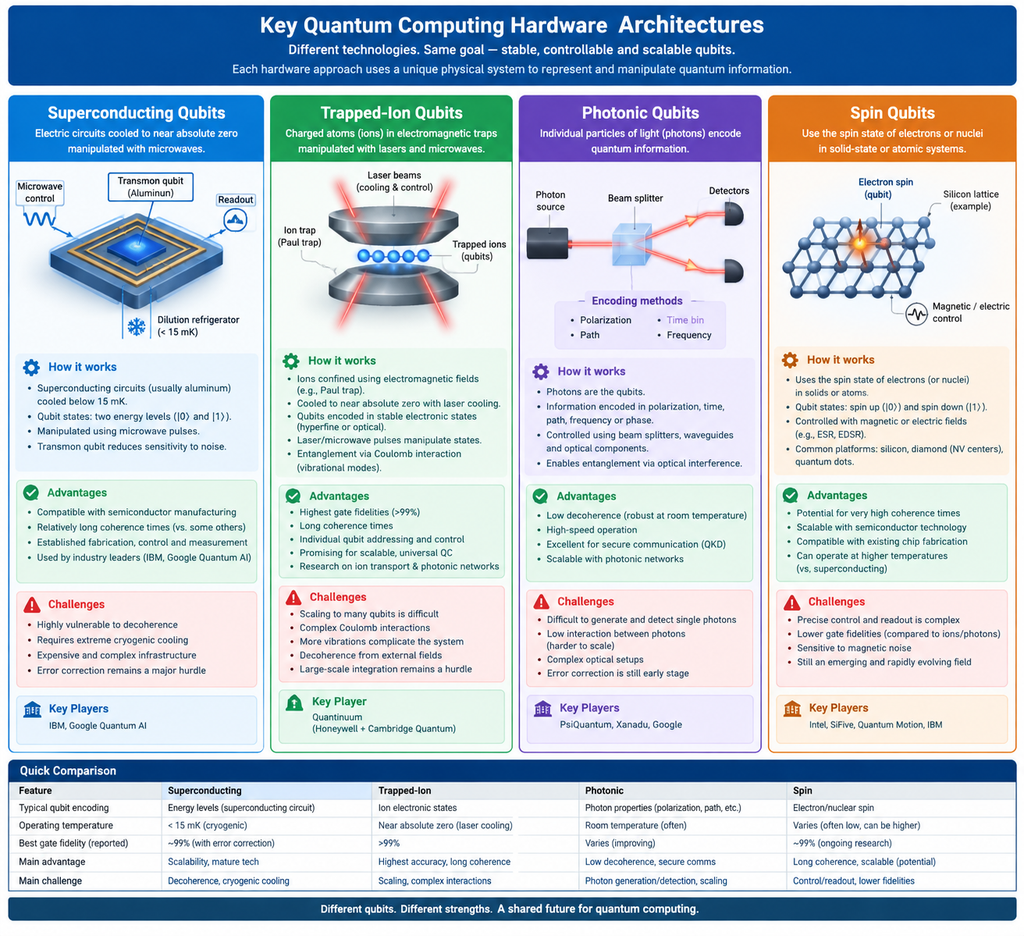
The physical realization of qubits presents a formidable engineering challenge, primarily due to the minuscule scale at which quantum phenomena manifest and the extreme fragility of quantum states. Consequently, a diverse array of technological approaches are being explored globally to construct stable, controllable, and scalable quantum computing hardware. Each modality possesses distinct advantages and inherent challenges, contributing to a heterogeneous landscape of quantum hardware development.
Superconducting qubits are among the most promising technologies in quantum computing. Their working principles are rooted in superconducting electronic circuits, typically fabricated from materials like aluminum. These circuits must be cooled to extremely low temperatures, often below 15 millikelvin (mK), which is near absolute zero, to exhibit zero electrical resistance. The qubit’s state is represented by two energy levels—a ground state (0) and an excited state (1)—and is precisely manipulated using electromagnetic fields, particularly microwaves. The transmon qubit is a widely adopted type within this modality, specifically designed to minimize sensitivity to environmental noise while maintaining quantum coherence.
The advantages of superconducting qubits include their compatibility with existing semiconductor manufacturing technologies, which offers a pathway for scalability in large quantum processors. They also exhibit relatively long coherence times compared to some other qubit types and benefit from a well-established infrastructure for their fabrication, control, and measurement. Major industry players such as IBM and Google Quantum AI are extensively investing in and utilizing superconducting qubits in their quantum computing research and development.
Despite these advantages, superconducting qubits face significant challenges. They remain highly vulnerable to decoherence, the loss of their quantum state due to unwanted interactions with the environment, which limits the duration for reliable computations. The necessity for extreme cryogenic cooling imposes complex and expensive infrastructure requirements, significantly increasing the overall cost and operational complexity of quantum computers. Furthermore, developing robust error correction techniques to mitigate their inherent sensitivity to noise remains a critical and ongoing hurdle.
Trapped-ion quantum computers utilize charged atomic particles, or ions, which are confined and manipulated in free space using precisely controlled electromagnetic fields generated by devices known as ion traps, such as Paul traps. These ions are cooled to temperatures near absolute zero using laser cooling techniques, which minimizes their motion and enables exquisite control over their quantum states. Qubits are encoded in the stable electronic states of individual ions, with different states corresponding to the |0⟩ and |1⟩ qubit states (e.g., hyperfine or optical qubits). Quantum operations are performed by applying specific laser or microwave pulses that manipulate the internal states of the ions and control their interactions. Entanglement between ion qubits is achieved through their mutual Coulomb interaction, mediated by their collective vibrational modes.
Trapped-ion systems have demonstrated the highest accuracy in fundamental quantum operations to date, with single-qubit gate fidelities often exceeding 99% and two-qubit entangling gates achieving similar precision. They offer long coherence times and the ability to individually address and control each qubit. This modality is considered a highly promising architecture for scalable, universal quantum computers, with ongoing research exploring schemes like transporting ions in arrays and utilizing photonic networks for connectivity. Quantinuum, formed from Honeywell and Cambridge Quantum, is a leading entity in trapped-ion quantum computing.
However, scaling up the number of qubits in trapped-ion systems presents a significant challenge. As more ions are introduced into a trap, the complexity of their Coulomb interactions increases, and additional vibrations can complicate the quantum system, making initialization and computation more difficult. Decoherence remains a concern, particularly from interactions with external electromagnetic fields or non-uniform magnetic fields encountered during ion transport. While compact demonstrators have been developed, integrating the necessary technology into practical, large-scale systems remains a substantial engineering hurdle.
Photonic Quantum Computing (PQC) employs individual particles of light, known as photons, as its fundamental qubits. Quantum information can be encoded in various properties of photons, such as their polarization (horizontal or vertical) or their path of travel. A notable advantage of photons is their natural resilience to certain types of noise sources due to their limited environmental interactions, which is a significant factor plaguing other qubit modalities. Photons can also maintain their coherence over long distances, making this modality particularly attractive for future quantum networking applications that connect quantum computers at the speed of light via existing fiber optic cables. Operations in PQC primarily involve linear optical components, interferometry, and photodetectors, with photons actively moving through their circuits at the speed of light, as they cannot be held stationary. Key developers in this area include Xanadu and PsiQuantum.
PQC offers the potential to perform simpler quantum computations at room temperature, which would significantly reduce the complexity and costs associated with cryogenic cooling, paving the way for smaller, more easily integrated quantum computers. These systems are capable of high-speed operations and are considered ideal for scalable quantum computing with lower power consumption compared to traditional quantum computers. Photonic chips have demonstrated the ability to generate over 8,000 pairs of entangled photons per second, showcasing their potential for complex operations.
Despite these promising attributes, photonic qubits face distinct challenges. A significant issue is photon loss, which can occur in substantial numbers and necessitates robust quantum error correction (QEC) schemes, such as Low Density Parity Check (LDPC) codes, to ensure the reliability of measurement results. Although PQC is often highlighted for its room-temperature operation, certain critical components may still require bulky cryogenic equipment. Building large, error-free systems with millions of qubits requires precise control over numerous photons, which is complicated by inherent losses, noise, and the intricate engineering of large-scale optical circuits. Developing fault-tolerant architectures and efficient error detection methods remains a major hurdle for this technology.
Spin qubits encode quantum information into the intrinsic spin of charge carriers, typically electrons, confined within semiconductor devices, often in microscopic wells known as quantum dots. The two-level system of an electron’s spin (spin up or spin down) naturally serves as a qubit. These qubits are manipulated by applying voltages to gate electrodes positioned above the quantum dots, which control the electron spins. While the name “silicon spin qubits” is common, implementations have also been demonstrated in other semiconductors like gallium arsenide, germanium, and graphene. Different classifications exist, including single spin qubits, donor spin qubits, singlet-triplet spin qubits, and exchange-only spin qubits, each with specific encoding and operation mechanisms. Intel is a prominent entity actively researching silicon spin qubits.
Spin qubits benefit from over 26 years of dedicated research and development since their initial proposal. They offer relatively long coherence times, crucial for maintaining quantum information during computation. Their compatibility with existing semiconductor fabrication technology makes them comparatively inexpensive to produce and offers a pathway for integrating a vast number of qubits onto a single chip due to their small size. Furthermore, spin qubits can operate at relatively higher temperatures (a few kelvins) compared to superconducting qubits, which helps reduce the demanding operating costs associated with extreme cryogenics. The semiconductor substrate itself provides a degree of protection from environmental noise, and fast gate speeds allow for more operations within coherence times, offering enhanced control.
Despite their advantages, silicon spin qubits face several development challenges. These include susceptibility to charge noise caused by electrostatic fluctuations, issues with valley splitting where energy levels in the quantum dot are too close, and spatial variations in the electron g-factor that reduce control precision. Fabrication inconsistencies and instability across various temperature ranges also present hurdles. A significant impediment to their accelerated development has been the lack of publicly available spin qubit quantum computers, which contrasts with the open access models that have spurred progress in other modalities. Integrating these qubits seamlessly with classical control electronics also remains a complex task.
Beyond the primary modalities, several other promising architectures are under active investigation:
- Neutral Atom Quantum Computing: This approach utilizes individual neutral atoms as qubits. Companies like Atom Computing have developed systems featuring large arrays of atoms, with some platforms populated with over 1,000 qubits. Pasqal is another leading developer in this area, with ambitious roadmaps for increasing logical qubit counts.
- Topological Qubits: Topological quantum computing aims to encode quantum information in exotic quasiparticles, such as non-Abelian anyons or Majorana zero modes. This approach leverages their inherent braiding statistics to perform fault-tolerant quantum operations with intrinsic error protection, making them theoretically more robust against decoherence. Microsoft is a key proponent of this technology, having introduced the Majorana 1 processor in February 2025, which is designed with the long-term goal of scaling to a million qubits.
- Quantum Annealing: This is a specialized form of quantum computing distinct from universal gate-based models. Quantum annealers are specifically designed for optimization and sampling problems, rather than general-purpose computation. D-Wave Systems is the prominent leader in this field, with their Advantage2 system featuring over 4,400 qubits. These systems operate by leveraging the quantum physics of superconducting loops as qubits, using superposition and entanglement to find low-energy states that correspond to optimal or near-optimal solutions. While D-Wave claims to have demonstrated quantum advantage for specific optimization problems, classical methods have shown competitive performance in certain instances, leading to ongoing debate regarding their comparative efficacy.
The hardware landscape is characterized by diversification and specialization, rather than a single dominant solution emerging at this stage. This observation stems from the clear delineation of multiple qubit modalities, each possessing unique operational principles, advantages (e.g., scalability for superconducting, high fidelity for trapped-ion, room-temperature potential for photonic, higher operating temperatures for spin), and distinct challenges (e.g., extreme cryogenics, photon loss, noise sensitivity). Furthermore, specialized approaches like quantum annealing are explicitly recognized as distinct from universal quantum computing. This indicates that the field is not converging on one “winner” but is actively exploring multiple pathways to achieve scalable and fault-tolerant quantum computation. This implies that organizations seeking to adopt quantum technology cannot simply select a single “best” hardware platform; rather, they must carefully consider the specific computational problem they aim to solve and choose the modality or hybrid approach that aligns most effectively with their objectives. This necessitates the development of software and middleware capable of abstracting away hardware specifics to facilitate broader application development. The continued substantial investment across these diverse modalities by major global players underscores the inherent uncertainty and the high-stakes competitive environment in the pursuit of viable quantum computing solutions.
A critical aspect of this hardware development is that the pursuit of higher qubit counts is inextricably linked with the challenge of qubit quality and error correction. While impressive raw qubit counts have been achieved, such as IBM’s Condor at 1,121 qubits and Atom Computing’s neutral atom system at 1,180 qubits , it is widely acknowledged that simply increasing the number of physical qubits does not automatically translate to increased computational power or utility. The true bottleneck lies in maintaining qubit coherence and achieving high fidelity operations, which are essential for performing complex computational tasks without errors. Decoherence remains a persistent challenge across all modalities. This necessitates sophisticated error correction techniques, which currently require a large overhead, often thousands of physical qubits, to create a single stable “logical qubit”. This means that the “race to higher qubits” is not a simple linear progression but a complex engineering and physics challenge focused on building robust logical qubits from many physical, error-prone ones. The development of fault-tolerant quantum computers, as targeted by IBM , is fundamentally dependent upon breakthroughs in error correction, which will ultimately determine when quantum computing transitions from Noisy Intermediate-Scale Quantum (NISQ) devices to systems capable of solving practical, large-scale problems with high reliability.
Table 3.1: Comparison of Major Qubit Modalities
| Modality | Working Principle | Key Advantages | Primary Challenges | Leading Players |
| Superconducting Qubits | Josephson junctions in superconducting circuits, manipulated by microwaves. | Scalability with semiconductor tech, relatively long coherence times, mature fabrication infrastructure. | Extreme cryogenic requirements, high sensitivity to decoherence/noise, complex error correction. | IBM, Google Quantum AI, Rigetti, SpinQ |
| Trapped-Ion Qubits | Electronic states of charged atoms confined by electromagnetic fields, manipulated by lasers/microwaves. | Highest gate fidelity/accuracy, long coherence times, individual qubit addressing. | Scaling qubit number, complex ion transport, noise from environment/transport. | IonQ, Quantinuum |
| Photonic Qubits | Individual photons as qubits, encoded in polarization or path, manipulated by linear optics. | Natural resilience to certain noise, long-distance communication (quantum networking), potential for room-temperature operation (for some components). | Significant photon loss, complex error correction schemes, bulky cryogenic equipment for certain components. | Xanadu, PsiQuantum |
| Spin Qubits | Intrinsic spins of electrons (or nuclei) in semiconductor quantum dots, manipulated by voltages/magnetic fields. | Compatibility with semiconductor fabrication (scalability), relatively higher operating temperatures, long coherence times, high qubit density. | Charge noise, valley splitting, fabrication inconsistencies, integration with classical electronics, lack of public access. | Intel, Diraq, Silicon Quantum Computing |
| Quantum Annealing | Superconducting loops as qubits, leveraging superposition/entanglement to find low-energy states for optimization problems. | Specialized for optimization/sampling problems, demonstrated speed-ups for specific tasks. | Not a universal quantum computer (limited applicability), classical methods remain competitive for some problems, requires extreme cryogenics. | D-Wave Systems |