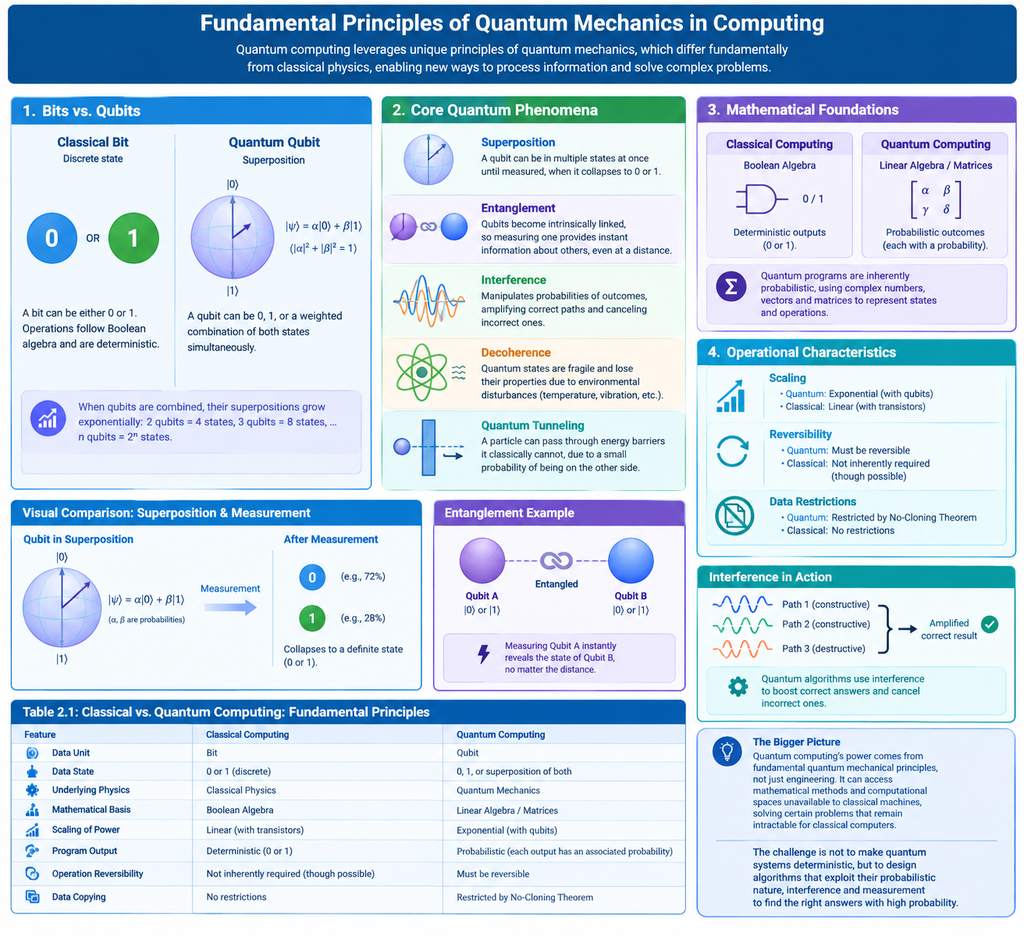
The operational foundation of quantum computing is rooted in principles that diverge significantly from classical computation. Understanding these fundamental distinctions is paramount to appreciating the unique capabilities and inherent complexities of quantum systems.
Classical computers process and store data using bits, which are discrete units of information represented as either a 0 or a 1. Operations on these bits adhere to Boolean algebra, yielding deterministic outcomes. In contrast, quantum computers utilize quantum bits, or qubits, which can represent information not only as a 0 or a 1 but also as a weighted combination of both states concurrently. This unique characteristic is known as superposition. The capacity of qubits to exist in such indeterminate states enables them to perform multiple calculations simultaneously. As qubits are combined, their superpositions grow exponentially in complexity: for instance, two qubits can exist in a superposition of four possible states, three qubits in eight, and so forth, leading to an astronomical range of possibilities with a larger number of qubits.
Several core quantum mechanical phenomena underpin the functionality of quantum computers:
- Superposition: This principle allows a quantum particle, such as a qubit, to exist in a combination of multiple possible states or locations simultaneously until it is measured. For example, a qubit can effectively be both a 0 and a 1 at the same time. This ability to represent information in novel ways is a foundational element enabling quantum computation. However, upon measurement, the quantum system’s state collapses from its superposition of possibilities into a definite binary state, either a 0 or a 1.
- Entanglement: When quantum objects interact, they can become intrinsically linked through a connection termed entanglement. This correlation persists even if the objects are separated by vast distances, a phenomenon famously described by Albert Einstein as “spooky action at a distance”. In quantum computing, entanglement enables qubits to correlate their states. Consequently, measuring a single entangled qubit can instantaneously provide information about other qubits within the entangled system. This property is indispensable for executing complex quantum operations.
- Interference: Often referred to as the “engine” of quantum computing, interference is leveraged to manipulate the probabilities of computational outcomes. When qubits are placed into a collective superposition, they structure information in a wave-like manner, with amplitudes associated with each potential result. Quantum algorithms are designed to exploit this interference, amplifying the probabilities of correct computational paths while causing the probabilities of incorrect paths to cancel each other out.
- Decoherence: Quantum states are inherently delicate and highly susceptible to environmental disturbances, including temperature fluctuations, vibrations, or electromagnetic interference. Decoherence describes the process by which a quantum system loses its quantum properties and collapses into a non-quantum state, resulting in the loss of quantum information. To counteract this, scientists must meticulously isolate qubits from their surroundings, often requiring extreme cooling to temperatures just fractions of a degree above absolute zero or the creation of vacuum conditions. Decoherence fundamentally limits the duration for which computations can be reliably performed before errors accumulate.
- Quantum Tunneling: This intriguing quantum phenomenon allows a quantum object, such as an electron, to sometimes pass through energy barriers that it would classically be unable to overcome. This occurs because superposition permits a small, non-zero probability of the particle existing on the other side of the barrier. While not as central to the core computational model as superposition and entanglement, quantum tunneling finds practical applications in various quantum technologies, including flash memory devices and quantum computers themselves.
The mathematical underpinnings of quantum computing also diverge from classical paradigms. Classical computing operates based on Boolean algebra, which dictates deterministic outputs of either 0 or 1. In contrast, quantum computing relies on linear algebra and matrices to define operations and the states of qubits. Consequently, quantum programs are inherently probabilistic, meaning each possible output has an associated probability, unlike the deterministic results of classical programs.
Several operational characteristics further distinguish quantum from classical computing:
- Scaling: A critical difference lies in how computational power scales. The power of quantum computers increases exponentially with each additional qubit, whereas classical computers scale linearly with the number of transistors. This exponential scaling is a direct consequence of superposition, allowing simultaneous exploration of vast numbers of possibilities.
- Reversibility: Quantum circuits are fundamentally required to be reversible, implying that the input state of an operation can be precisely recovered from its output. This property is not an inherent requirement for most classical circuits, though they can be designed to be reversible.
- Data Restrictions: The no-cloning theorem, a fundamental principle of quantum mechanics, prohibits the creation of an exact copy of an arbitrary unknown quantum state. This imposes a significant limitation on data copying within quantum computers, an issue that does not exist in classical computing.
A critical understanding emerging from this comparison is that the computational power of quantum systems stems from their adherence to fundamental quantum mechanical principles, rather than merely engineering advancements. This distinction implies that certain problems, which are computationally intractable for classical computers due to their linear scaling, will inherently remain so, irrespective of how much classical hardware improves. Quantum computers, by operating on different physical laws, can access mathematical methods and computational spaces that are simply unavailable to classical machines, offering a path to solve these “unsolvable” problems. This foundational difference underpins the entire rationale for investing in quantum computing as a distinct and necessary technology, rather than merely a faster version of existing computational tools.
Furthermore, the probabilistic nature of quantum computation and the phenomenon of state collapse upon measurement are not deficiencies but intrinsic properties of quantum mechanics. The challenge for quantum computing is not to force these systems into deterministic behavior, but rather to design algorithms that strategically exploit this inherent probabilistic nature and the measurement-induced collapse to extract desired solutions with high probability, while simultaneously leveraging interference to suppress unwanted outcomes. This necessitates the development of entirely new algorithmic design paradigms and error correction strategies, which are profoundly different from those employed in classical computing. The inherent difficulty in translating quantum information into classical results further highlights the need for robust post-processing mechanisms and the development of hybrid architectures where classical computers interpret the probabilistic outputs of quantum processors.
Table 2.1: Classical vs. Quantum Computing: Fundamental Principles
| Feature | Classical Computing | Quantum Computing |
| Data Unit | Bit | Qubit |
| Data State | 0 or 1 (discrete) | 0, 1, or superposition of both |
| Underlying Physics | Classical Physics | Quantum Mechanics |
| Mathematical Basis | Boolean Algebra | Linear Algebra / Matrices |
| Scaling of Power | Linear (with transistors) | Exponential (with qubits) |
| Program Output | Deterministic (0 or 1) | Probabilistic (each output has an associated probability) |
| Operation Reversibility | Not inherently required (though possible) | Must be reversible |
| Data Copying | No restrictions | Restricted by No-Cloning Theorem |